
How To Get Cited in AI Search With YouTube
Data Strategy and YouTube Audience Insights, Touchstorm & Touchstorm DATALabs
Over the last few months, almost every brand we’ve worked with has had the same question. How do we show up in ChatGPT, Claude, Google’s AI Overviews, and the growing list of AI platforms that answer questions for our customers?
And that appetite makes sense. Search is changing fast. More people are getting answers directly from LLMs and conversational search experiences before they ever click a traditional result. The click is becoming optional, and for brands that built their entire digital presence around earning it, that’s a real problem.
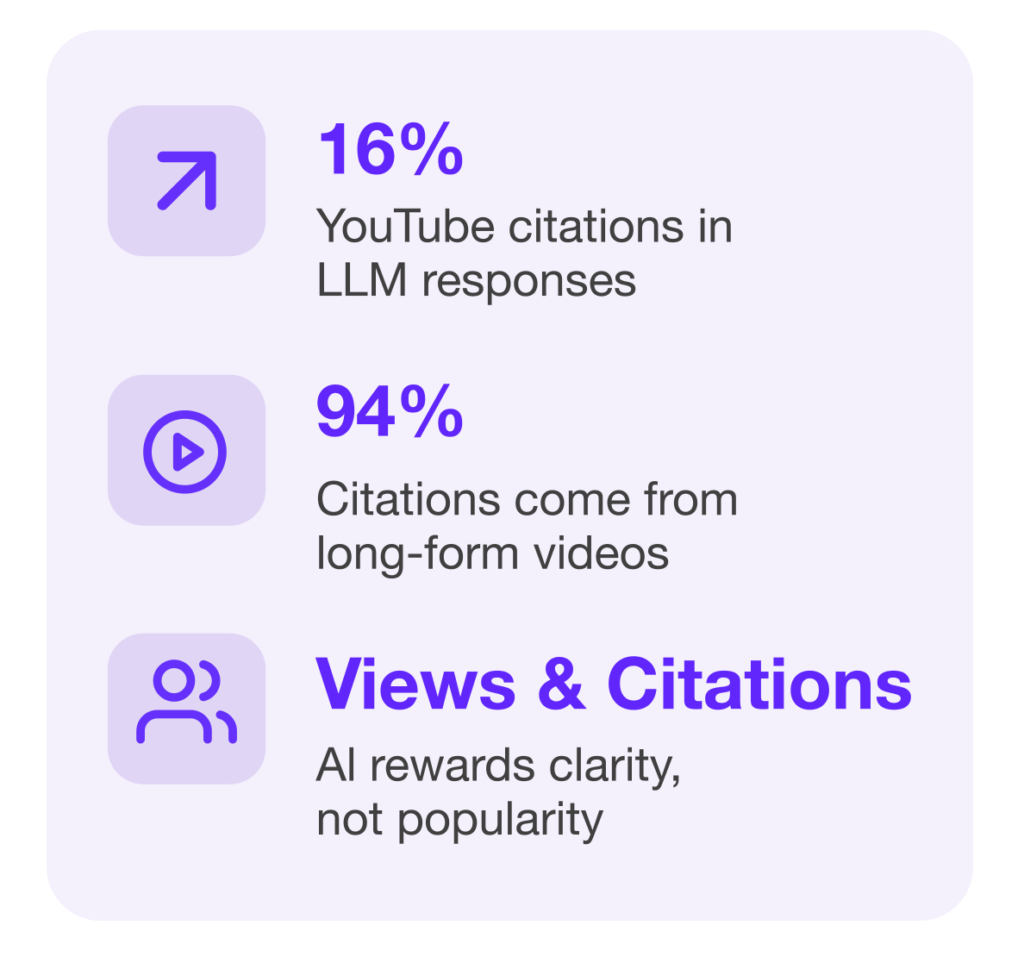
- Recent data from Adweek and Bluefish shows YouTube was cited in 16% of LLM responses in the second half of 2025, surpassing Reddit’s 10%. A significant reversal from early 2025, when Reddit was the most-cited social platform in AI responses. This is because YouTube provides AI-friendly text signals like titles, transcripts, and chapters.
- Of all the social media posts cited by AI, YouTube claims the lion’s share at 31.8% according to OtterlyAI’s 2026 YouTube Citation Study. Notably, 94% of these citations involve long-form content rather than Shorts, with citation frequency showing almost no link to traditional metrics like views or subscribers.
AI Is Changing the Rules of YouTube Optimization
That last point is the one brands need to hear. AI systems do not appear to be citing videos simply because they are popular. They are citing videos because they are useful, clear, structured, and easy to extract.
The major problem? A large brand channel can lose the citation to a smaller creator if the creator answers the question better.
That is the uncomfortable truth, and it should change how we think about YouTube optimization.
For years, most brands have treated YouTube strategy as a visibility game: will people see this, click this, and watch this?
Those questions still matter. But AI search adds a new question: “Would an AI system understand, trust, and cite this video as a useful answer?” That is the new bar.
Why Does YouTube Perform Well in AI Search Results?

YouTube has a major advantage in this new environment because video carries both human value and machine-readable context.
For people, video shows proof. A product can be demonstrated. A process can be walked through. A feature can be explained on screen. A subject matter expert can show experience, not just claim it.
For AI systems, YouTube videos come with structured signals: titles, descriptions, transcripts, captions, chapters, timestamps, playlists, and linked resources. Those signals help AI understand what the video is about and where specific answers live.
This is why long-form video matters so much. A strong long-form video can cover a topic in depth, but it can also be broken into smaller, specific answer moments. That is especially important as search becomes more conversational.
Big Signal:
Google is already testing a feature called Ask YouTube for Premium users in the US and is scheduled to launch in the summer of 2026. The feature allows users to ask conversational questions, receive an AI-generated answer, see cited videos, click into timestamped sections, and ask follow-up questions in the same thread.
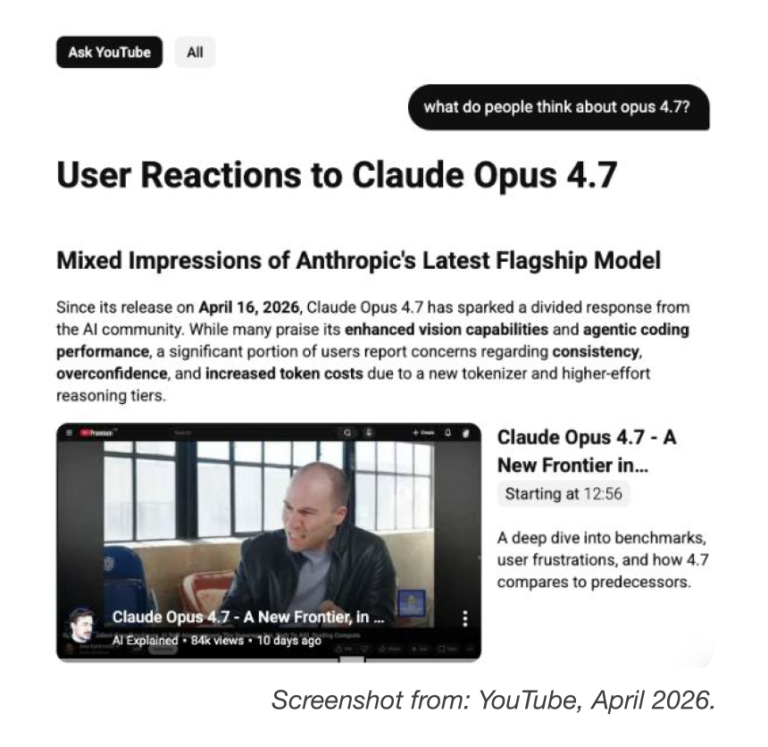
YouTube is not only organizing videos by title or keyword. It is moving toward answers, clips, and specific moments inside videos.
That makes segment-level clarity more important than ever.
A polished brand film that vaguely circles a topic may look good, but it may not be the best source for AI. A clear 10-minute explainer with direct answers, strong chapters, and a clean transcript may be far more valuable in AI search.
Do YouTube Chapters Affect AI Citations?
This is where Touchstorm is already ahead of the curve.
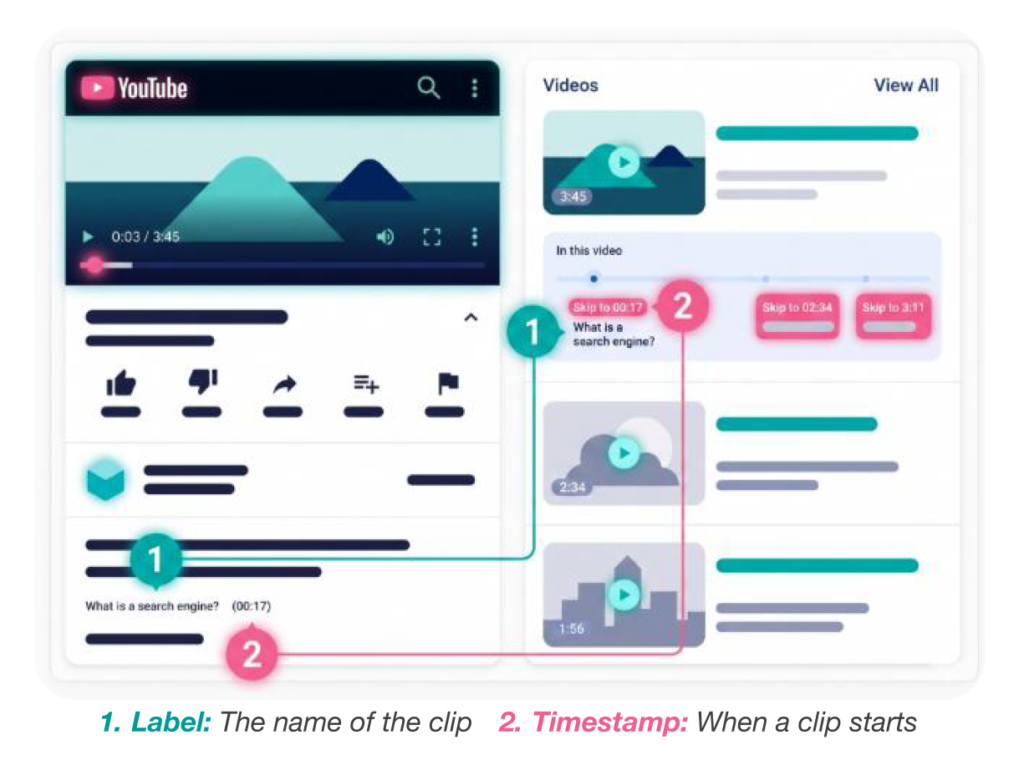
When YouTube chapters became available in 2020, we treated them as more than a viewer convenience feature. We used them as a way to make videos more searchable, more understandable, and easier to navigate.
That approach has already produced major search gains in some cases. Our first chapter optimization test, conducted 16 months after YouTube chapters became available, drove a 272% overall increase in Organic YouTube Views and a 413% overall increase in Google Search Views.
Now, AI search gives that work even more importance.
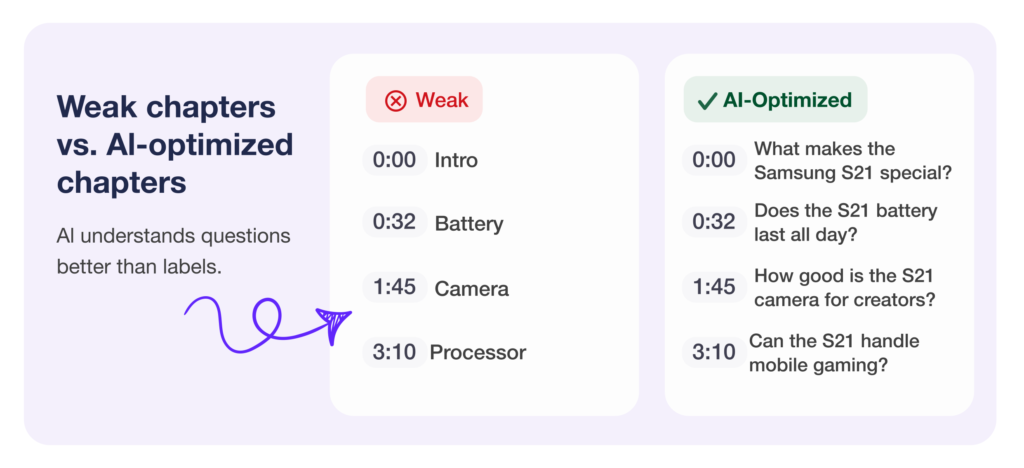
Chapters and timestamps turn long-form videos into smaller answer units. AI is rarely looking for the entire video. It is looking for the specific section that answers the user’s question.
That means vague chapters are not enough.
The difference is clarity. The weak version helps the viewer skim. The AI-Optimized version helps the viewer and the machine understand the answer structure.
By prioritizing this granular methodology, we have stayed ahead of the curve for years. It is proof that foundational SEO practices remain a powerful advantage, even as the search environment evolves.
In short, Chapters are becoming an AI citation architecture.
What makes a video citation-worthy?

Answer real questions
Get to the point early. State the problem and solution clearly.
Structure your content
Use clear chapters and transitions so AI can find the answers.
Search-friendly language
Mirror the questions your audience is actually asking.
Optimize transcripts
Clean, accurate transcripts help AI understand your content.
Build credibility
Link to sources, data, and expert references.
Create content clusters
Build topic authority with connected videos and playlists.
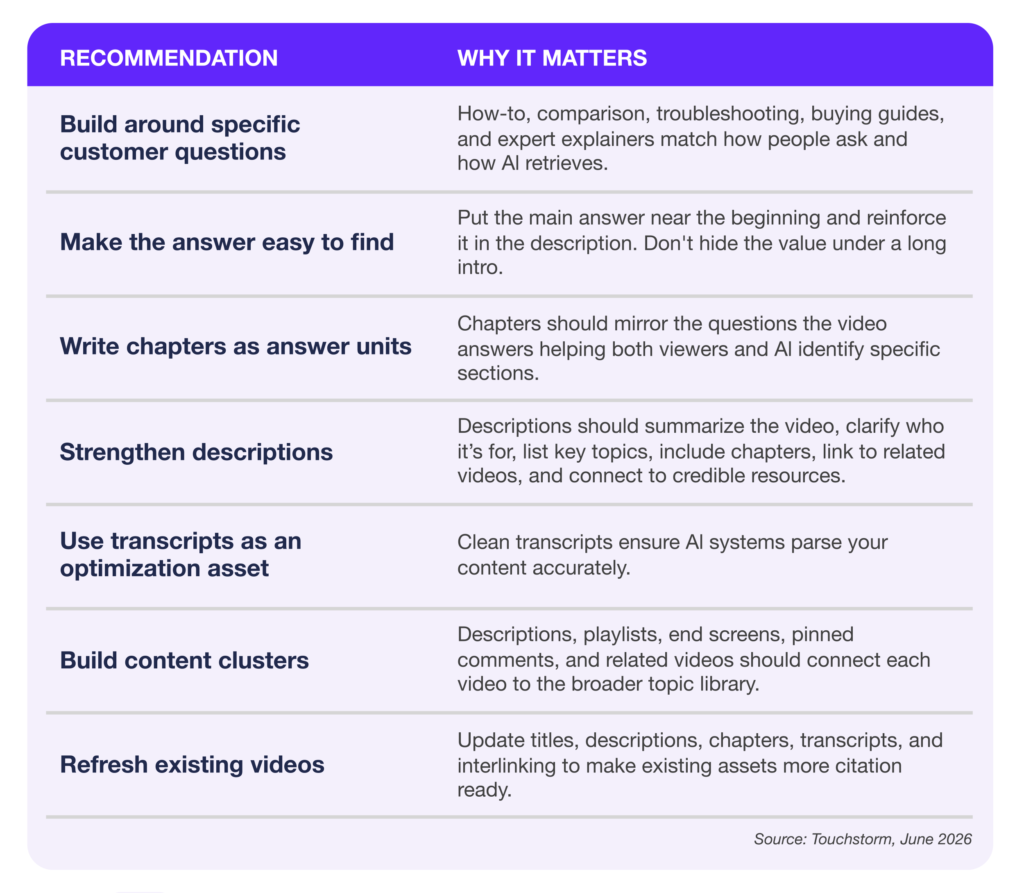
What Touchstorm recommends now
We are not treating AI search as a future trend. We’re already adapting our YouTube strategy work around it. Here’s what we recommend for every brand and creator.
What will YouTube AI search optimization look like next?

The brands that win in AI search will not be the ones that simply upload more videos.
They will be the ones that build the most useful, structured, trustworthy answer libraries in their category.
That is where YouTube can become a real advantage. It gives brands a way to show expertise, demonstrate proof, answer customer questions, and build authority in a format that both people and AI systems can understand.